
By James Pointon, Director at Higher Performance. Published July 2026.
Website builders such as Wix, Squarespace and GoDaddy let a Suffolk business get online in a weekend for very little money. A bespoke build costs more and takes longer, but gives you full control over speed, structure and search visibility. The right choice depends on one question: whether your website needs to bring in work, or simply needs to exist.
Most people ask this question the wrong way round. They start with the platform and work towards the goal. It works better in reverse.
What do website builders do well?
They remove the barrier to getting started, and that has real value.
You can have a presentable site live within days, without a developer, for the price of a monthly subscription. Hosting, security and updates are handled. For a new venture testing whether there is a market, that is a sensible use of money.
They also produce good-looking results. The templates are professionally designed, and a careful owner can put together something that reflects the business reasonably well.
For a sole trader who needs somewhere to send people, a builder does the job.
Is looking presentable the same as being persuasive?
No, and this is the part most people underestimate.
Everyday Leader in Framlingham is a useful example. Colin Tapscott is an EMCC accredited leadership coach with thirty years behind him, two published books, a TEDx talk and Suffolk County Council among his clients. His previous website functioned perfectly well. It simply undersold every bit of that.
We ran a branded photo shoot before designing a single page, then structured the site around how a prospective client decides. His accreditations, his books and his client work now carry weight in the first few seconds rather than sitting three clicks down.
Templates are good at looking tidy. What they struggle with is carrying the specific evidence that makes one business more credible than the next, particularly when that evidence is the whole reason someone should choose you.

Where do website builders start to cost you?
The trouble begins when the website is expected to generate enquiries rather than confirm you exist.
Builders decide how your pages are coded, and you inherit those decisions. That affects load speed, which affects rankings. It limits how much control you have over schema markup, internal linking and page structure, which are the levers that move a site up Google.
You also hit a ceiling on scale. A five-page site is comfortable. A site that needs twenty service pages and location pages for Bury St Edmunds, Ipswich, Sudbury and Stowmarket becomes awkward to organise and slow to load.
Then there is ownership. Your site lives on their platform, in their format. Moving it later means rebuilding it, not exporting it.
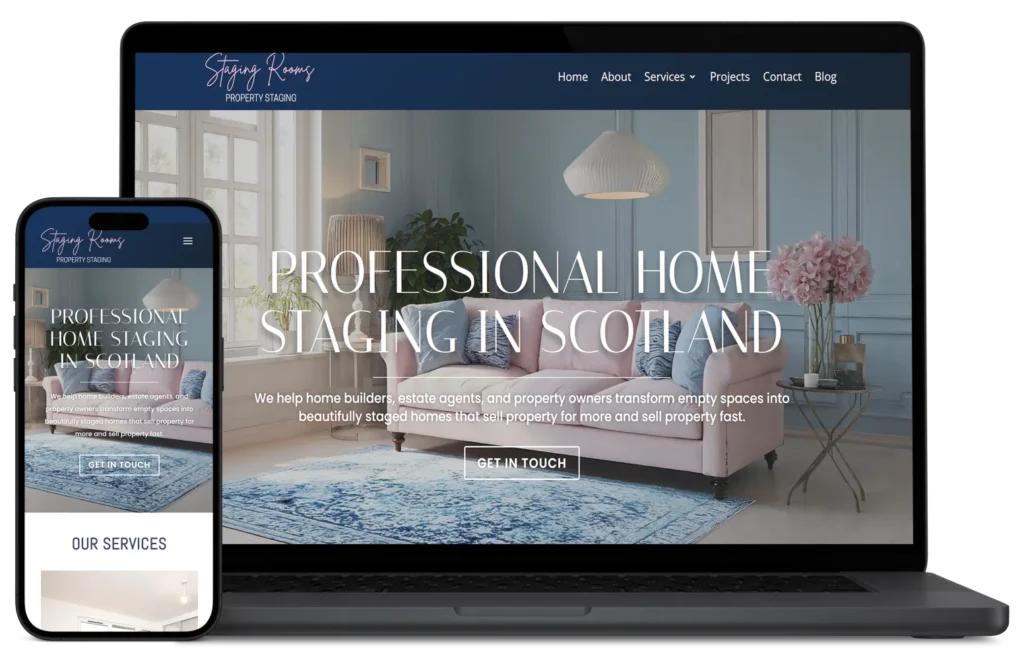
Staging Rooms in Aberdeen came to us on a Wix template that did not reflect the quality of their work and generated very little. We rebuilt them on bespoke WordPress. The site now produces over 126,000 impressions a year, ranks number one for “Home Staging Aberdeen”, and sits on page one for “home staging Scotland”.
Aberdeen rather than Suffolk, admittedly. The platform ceiling does not vary by county.
Is the platform the whole problem?
No, and this is where the argument usually gets oversimplified.
SMK Grab Hire were already on WordPress when they came to us. Their site was slow, hard to navigate and close to unusable on a phone, which mattered enormously given where their customers were searching from.
We rebuilt it with a commercial focus rather than switching platform for its own sake. It now generates over 8,700 impressions and 102 enquiries from a single search term.
A bad bespoke site beats nothing and loses to a good template. The platform sets your ceiling. The thinking behind the build decides whether you get anywhere near it.
When is it worth moving off a website builder?
Four signals suggest the ceiling is close.
You are competing on search. If customers find businesses like yours by typing a service and a town into Google, technical control stops being optional.
The site is growing past ten pages. Structure and internal linking start to matter more than appearance.
Mobile performance is poor. Mobile now accounts for around 64 per cent of global web traffic, and the share is higher again for local service searches. Slow mobile loading loses enquiries before anyone reads a word.
You want to sell, book or integrate. Payments, booking systems and connections to other software are where builders become restrictive or expensive.
If none of those apply, staying put is a reasonable commercial decision, and I would tell you so.
Will you lose your rankings if you migrate?
Not if the migration is planned. Rankings are lost through carelessness rather than through moving platform.
The work that protects them is unglamorous: mapping every existing URL to its new equivalent, setting permanent redirects, preserving the content that already ranks, and keeping the site structure coherent rather than reinventing it for the sake of a redesign.
Sites that lose visibility after a rebuild usually did so because nobody mapped the old pages, or because a new design quietly dropped content that was doing the ranking.
Handled carefully, a migration tends to improve rankings, since the technical foundations improve at the same time.
Which should a Suffolk business choose?
Start with what the website has to achieve in the next two years.
If it needs to look credible while the work comes from referrals and word of mouth, a builder is sufficient and you can spend the difference elsewhere.
If it needs to compete for local search against companies already ranking in Bury St Edmunds, Ipswich and across the county, you need the control a bespoke build gives you. Anything else is a ceiling you will pay to remove later.
My co-founder and I ran companies before this one, so the way we look at it is straightforward. The website is either an asset with a return or a line of cost. That answer decides the platform, not the other way round.
The website is also one part of a wider picture. Our guide to digital marketing in Suffolk covers how search, ads and content work together, and if you are assessing agencies rather than platforms, choosing a digital marketing agency in Suffolk sets out the questions worth asking.
Web design in Suffolk with Higher Performance
We build bespoke WordPress websites from Eagle House in Great Whelnetham, just outside Bury St Edmunds, with SEO engineered in from the first line of code rather than added afterwards.
Locally that includes Everyday Leader in Framlingham, alongside clients in Ipswich, Bury St Edmunds and across the county, and nationally from Aberdeen to Nottingham, which is a reasonable test of whether the approach travels.
Not every job is a rebuild. We also produce individual pages and ongoing site improvements for companies whose websites we did not build, including Marshall Gas in Ipswich, where targeted work made more commercial sense than starting again.
You can see the results behind those builds on our work.
If you are weighing up whether your current site is worth keeping, let’s talk about your website project. Tell us what you want it to achieve and we will tell you honestly whether a rebuild is the answer or whether targeted improvements would do.

Frequently asked questions
Can I move a Wix site to WordPress without losing my Google rankings? Yes, provided the migration is planned. Every existing URL needs mapping to its new equivalent with permanent redirects in place, and content that currently ranks needs preserving rather than rewriting. Done carefully, rankings usually improve after migration since the technical foundations improve too.
Is Squarespace bad for SEO? It is not incapable, but it is limited. You have less control over page speed, code structure and schema markup than a bespoke build allows. For low-competition markets that may be enough. For competitive local search it becomes a constraint.
How many pages before a website builder becomes limiting? Around ten to fifteen is where most businesses start to feel it. Beyond that, site structure, internal linking and load speed matter more than template quality, and those are the areas builders control on your behalf.
Do I own my website if I use a website builder? You own your content and your domain, but the site itself is built in the platform’s proprietary format. Moving elsewhere means rebuilding rather than exporting, which is worth understanding before you commit.
Do website builders work for local search in Suffolk? They can rank for low-competition terms, particularly with a well-maintained Google Business Profile. For competitive terms across Bury St Edmunds, Ipswich and the wider county, the technical limitations usually show.
James Pointon is co-founder and director of Higher Performance, an award-winning digital marketing agency based near Bury St Edmunds. He has more than three decades in sales and marketing, including building and selling a multi-million pound IT business. Connect on LinkedIn.